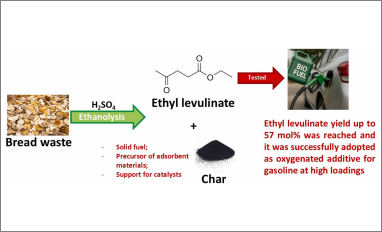
 Congratulations to our PhD student Lorenzo Bonaldi for his scientific publication entitled “Synthesis of ethyl levulinate from bread waste and its application as a versatile bio-additive for spark ignition internal combustion engines”.
Today, the global energy system is undergoing a major transition driven by socio-economic and environmental factors, leading to the progressive replacement of fossil fuels with renewable technologies. In this context, biofuels can play a key role due to their renewable nature and their compatibility with existing fuel infrastructure. Indeed, their use in internal combustion engines can result in a net reduction in CO2 emissions. The present study investigates the synthesis of ethyl levulinate (EL), a well-known and promising biofuel, using food industry waste as a raw material. From a sustainability and circular-economy perspective, the valorisation of waste streams for the production of value-added products represents a crucial strategy. Through a direct alcoholysis reaction, the waste feedstock was successfully converted into EL, achieving yields of up to 57 mol% by adopting a high-gravity approach. Renewable energy. In addition, part of the study focused on evaluating EL as a bio-additive for gasoline using a commercial engine. Unprecedentedly high blending ratios, up to 40 vol%, were tested without observing significant changes in engine performance.
Lorenzo’s work is available at the following link: https://doi.org/10.1016/j.jece.2025.119985